Recently I saw a post on social media that was celebrating a pastor for being a “Biblical pastor”, and as a former mainline Protestant-turned-Catholic, I wasn’t quite sure what the term meant. Apparently, at least in this case, “Biblical” meant defending the traditional ethics of sexual morality, in which only married couples are permitted to have sex. As much as I am a fan of that approach to sex and marriage, and I truly am, this seems like a woefully limited understanding of what a “Biblical pastor” would focus on.
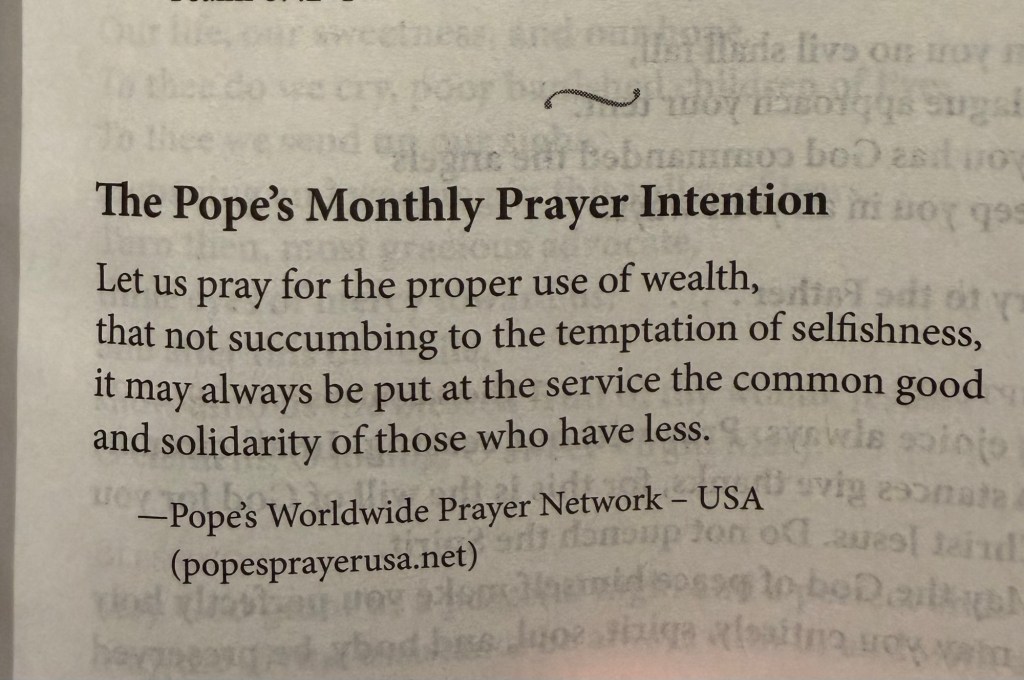
I mentioned last month that the pope has a specific prayer intention each month (it was for the Church to establish a mental health ministry in October). November’s prayer intention is a different level of Biblical:
Let us pray for the proper use of wealth, that not succumbing to the temptation of selfishness, it may always be put at the service of the common good and solidarity of those who have less.
That’s the short form; the whole prayer, which is available on the Vatican website, is so much richer:
Lord of life, all we have comes from You: the fertile land, the talents we’ve received, the effort of those who came before us. Nothing is ours alone — everything is a shared gift.
But so often, Lord, we let the wealth we seek or attain harden our hearts, lock us in selfishness, and make us forget the most vulnerable. Forgive us for storing up instead of sharing, for using goods as power rather than as service.
You remind us that true wealth is not found in what we keep, but in what we give with love. A heart detached from possessions transforms the world: it opens paths of justice, tears down walls of indifference, and sows hope among the poor.
We ask you, Lord, that your Spirit teach us to use what we have — money, time, talents, opportunities — as instruments of fraternity. May each economic, family, or community decision
spring from a free heart, able to recognize that every good is meant for all, and that only by sharing we build the future.Make us witnesses of a wealth transformed into service and mercy, so that our lives, united to the lives of others, may be a sign of your Kingdom of justice and peace.
Now, before I go deeper down the papal path, let me address the obvious point that “Biblical” and “Papal” aren’t necessarily the same thing. If that was your (very reasonable) thought, friends, have I got a book for you. Wealth, wages and the wealthy by Raymond F. Collins. While its target audience is preachers and teachers, it’s a great resource to all of the New Testament references to greed and the proper use of wealth. As he points out, there are three passages in the New Testament that speak about homosexuality, but nineteen speak about greed (p. xv). Collins goes beyond just those “greed” references to catalog all the ways that the New Testament authors deal with the use of wealth; the short story is, Pope Leo has a lot of the Bible backing his prayer intention for the month.
This is the last Sunday of the Catholic liturgical year, the Feast of Christ the King, and we get maybe one of the most famous parts of the Gospel dealing with how we use our stuff. Matthew 25:31-46 is perhaps the most clear statement in which Jesus talks about a final judgment, and the measure he uses to separate the sheep and the goats? “For I was hungry and you gave me food, I was thirsty and you gave me drink, a stranger and you welcomed me, naked and you clothed me, ill and you cared for me, in prison and you visited me.” This may be the most uncomfortably Biblical passage we have, and it is an unavoidable one.
Perhaps it seems as though Christians have chosen to forget this essential passage; I think that’s a fair critique. For what it’s worth, though, Catholic social thought puts this mindset of the right use of wealth at the center of its framework. In the short version of Pope Leo’s prayer, he references three central principles of Catholic social doctrine: the principle of the common good, the principle of the universal destination of goods, and the principle of solidarity. There are long intellectual pedigrees to these principles (and solid Biblical backing), but Leo’s encyclical Maginifica Humanitas has a beautifully written, concise summary in its second chapter. At about 20-25 pages, that second chapter isn’t too long for anyone to tackle, and I can’t recommend it highly enough. Maybe in a few months, when I have some more time on my hands, I’ll dig into it a little more.
In the meantime, what do we do with this more Biblical challenge? Given the season, may I recommend the Advent Conspiracy Movement? (Actually, there’s a book for this too, but I’m capped out on literary recs for this post.) It’s got a lot of excellent ideas for how to tackle the Biblical topic of the proper use of wealth, even in this runup to Christmas, in ways that make Advent more joyous, not less.
And if you, like me, find this whole discussion more uncomfortable and challenging than a social post about premarital sex, well, I’ve found that unless we’re being really challenged to live more self-sacrificial, loving lives by the Bible, we’re probably not reading enough of it to know what’s truly Biblical.


Leave a Reply