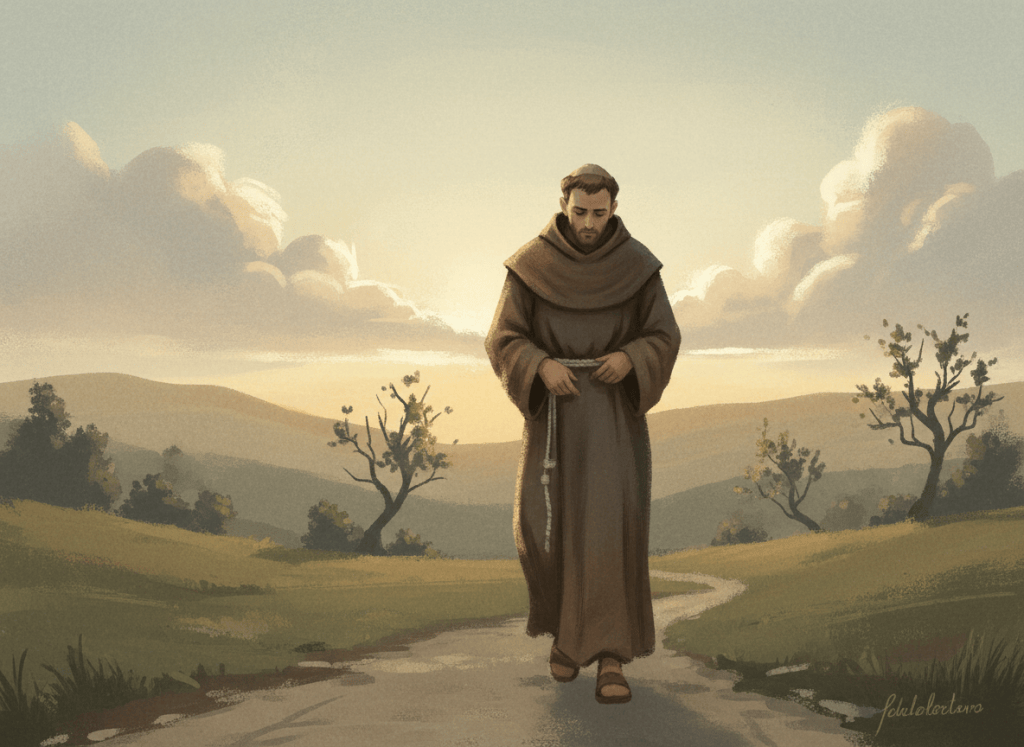
It’s comforting to know that even the best of them were works in progress.
I’ve written a lot about St. Francis of Assisi over the years, but this is a particularly big year for Franciscans, as it is the 800th anniversary of his death. While the daily Mass readings aren’t necessarily selected with St. Francis in mind, the ones from last Sunday up through Saturday, the evening of his death, are really good at reinforcing two themes I take from this great saint’s life.
The first is humility. Yesterday (Sunday, Sept. 27), we heard Ezekiel remind us to have the humility to recognize that God’s ways of mercy and justice are more fair than whatever we cook up, And in Philippians 2:1-11, we get Paul’s recounting of an early hymn about divine humility – that Christ “did not regard equality with God something to be grasped. Rather he emptied himself, taking the form of a slave, … becoming obedient to the point of death.”
Monday, Job, facing total disaster, cries “Naked I came forth from my mother’s womb, and naked shall I go back again. The Lord gave and the Lord has taken away; blessed be the name of the Lord!” Then we get Luke’s version of Jesus telling his disciples that the child, the least among all of us, is the one who is greatest.
Tuesday is a bit of a “vibe shift”, because it’s the feast of Saints Michael, Gabriel and Raphael. The readings aren’t very humility-focused, but it’s a reminder that it was while St. Francis was camped out on a barren mountain preparing for the feast of St. Michael that he (Francis) was marked with the stigmata, the bleeding wounds of Jesus, the ultimate sign of God’s humility.
Wednesday, we get Jesus telling would-be followers to prepare to be humbled. “Foxes have dens and birds of the sky have nests, but the Son of Man has nowhere to rest his head.” Thursday, Jesus sends out 72 followers and tells them to carry nothing with them and depend on the generosity of others, another call to humility. Friday (a feast for guardian angels, which some of us keep busier than others) is Matthew’s version of the Gospel we heard Monday: “Whoever humbles himself like this child is the greatest in the Kingdom of heaven.”
Finally, Saturday, Jesus welcomes back those 72, thanking God that “although you have hidden these things from the wise and the learned you have revealed them to the childlike.”
It’s not news that St. Francis leaned into this theme of humility; his nickname is Il Poverello, the little poor one.
But if you rewind the tape, there’s another theme that is at least as important.
At the very end of his life, after becoming the unlikely founder of a Christian renewal movement that numbered thousands and living a life that many have said is the closest facsimile to that of Jesus ever, St. Francis had this to say to his followers:
“Let us begin again, for until now we have done nothing.”
Even the best of us, at the end of the run, is still a work in progress.
That’s why the Gospel reading from last Sunday (Matthew 21:28-23) has been rolling through my mind for the last week or so. It’s a simple parable in which Jesus tells the religious leaders a story about a guy with two sons. He tells them both to go work in the vineyard. One says “Sure,” but never budges off the couch. The other says “No way,” but later comes around and gets out there. While Jesus’ point (still relevant) is that a lot of the goody-two-shoes believers say that they will love God and neighbor but don’t seem to follow through, while the outcasts, desperate to receive love, are actually a lot closer to hitting the mark, the other comforting lesson I get from this is that neither son sticks the landing on the response.
As someone who has clear memories of teenage Jeff telling Dad I would get right to mowing the lawn, only to let another Saturday’s daylight slip through my fingers, I relate to Son #1. As someone who has repeatedly set boundaries over what I would and wouldn’t do for God, only to eventually find myself lured beyond those boundaries by Love, Son #2 isn’t entirely foreign, either. I am such the work in progress.
Go back through the week, and that “work in progress” theme is like a subtle watermark. The disciples arguing over who’s #1 among them. The would-be followers who want to join Jesus’ gang, but are afraid of what they might have to give up. The 72, who come back trash-talking like an SEC team that just beat a rival. All of whom will both desert Jesus when he needs them most AND eventually come back around, even to the point of their own martyrdom. None of them stick the landing. All of them remain works in progress.
St. Francis, too. One of the useful things about his story is that, despite some of the dramatic moments in his conversion, it’s a story of repeated attempts by God to break through to the guy’s heart. He has a mini-mystical moment in his early party-boy days that he shrugs off. He comes back with PTSD from a year as a POW, but is drawn right back into the cycle of violence that defined status in that age. He answers God’s call to give up his crusade for knighthood, but then he just wanders around for a while. He overcomes his repulsion of lepers, but still remains a bit lost. Jesus speaks to him from a crucifix and tells him to rebuild His Church, but it takes Francis a while (and three HGTV-level renovation projects) before he realizes that God was speaking in broader, metaphorical terms. And so on.
As with all saints, time and nostalgia have recast Francis in a surreal light (as a sort of proto-hippie Dr. Doolittle, in his case). It’s out of love that his friends remembered and retold the best of him and left out most of the imperfections, but it’s too bad. Because those dying words of his are ones that we could use (well, I could use) every day:
Let’s begin again, for until now we have done nothing.


Leave a comment