The readings through the octave of Easter (the eight days from Easter Sunday through the following Sunday), include the different sightings of the resurrected Jesus as their Gospels. Since that means pulling from four different sources, they jump around a little chronologically, and they feel more like a collection of snapshots captured by different photographers than a narrative with a unified story arc.
The first readings for the octave all pull from the first few chapters of Acts of the Apostles (my favorite book in the Bible), and Monday-Saturday has more of a story arc. Peter preaches, Peter heals a guy born disabled, Peter gets in trouble with the authorities.
There’s a nifty line on Tuesday that hints at the underlying paradox that sparked the gospels, which is the tepid response to Christ by His fellow Jews compared to His much broader embrace by contemporary Gentiles: while Peter at this point is speaking exclusively to the Jewish community, he says “For the promise is made to you and to your children and to all those far off, whomever the Lord our God will call.”
I think the kids call that an Easter egg, coincidentally. God will be calling folks that the religious institutions never would have imagined, as still happens today.
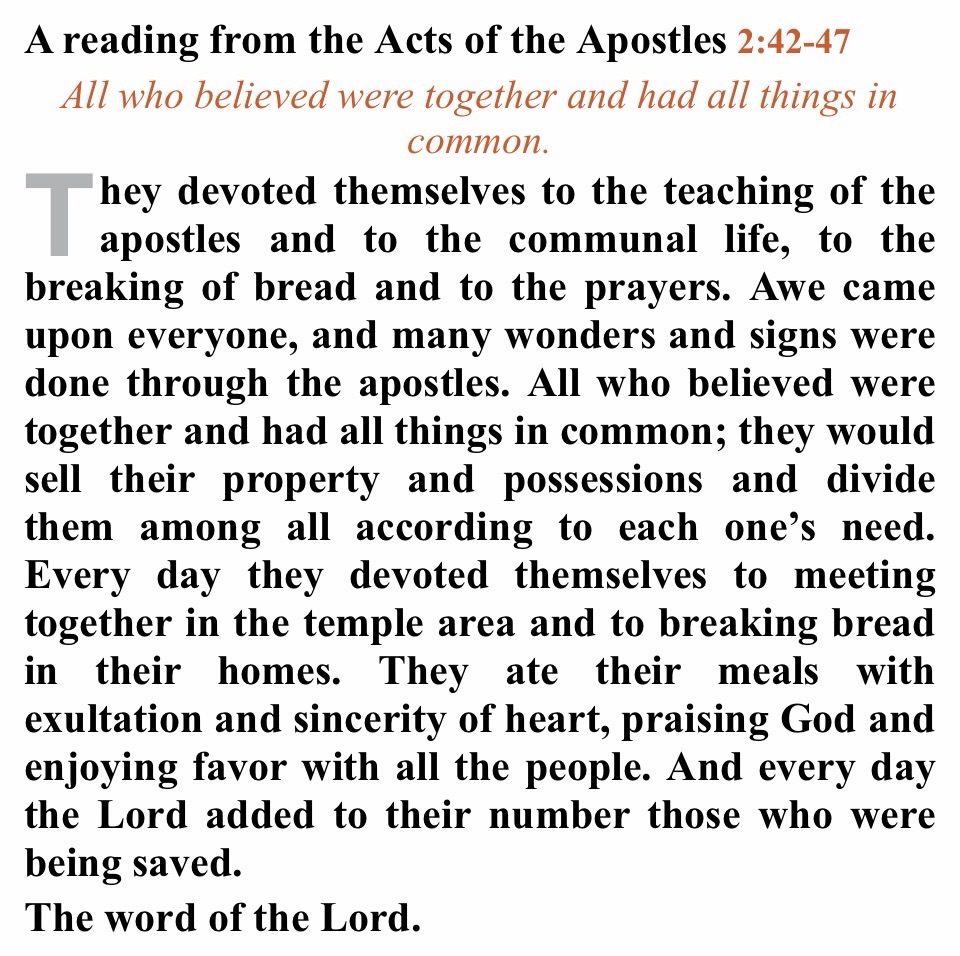
But Sunday backs up to Acts 2’s picture of a second Eden of sorts, and it’s really worth revisiting (Acts 2:42-47).
Some have said that this hippie-commune early Church is a myth; even if it really existed, it must not have lasted long, because shortly thereafter, there are factions in the group fussing to the Apostles about favoritism and people holding back on the “sell everything and give the cash to the community” vision (with comically disastrous consequences). But whether it was realized for a moment or not, these verses articulate what a communal Eden would look like to the evangelist.
“They devoted themselves to the teaching of the apostles and to the communal life, to the breaking of bread. And to the prayers.”
This kind of shared commitment to prayer, study and worship seems to lead to good things.
“Awe came upon everyone, and many wonders and signs were done through the apostles.”
Was the awe a function of how unlikely it is that people could stay that focused? Or was their focus a key that unlocked divine power?
“All who believed were together and had all things in common; they would sell their property and possessions and divide them among all according to each one’s need.”
It’s worth noting that the Garden of Eden only has a population of 2, so there’s not really a Biblical vision of a perfect community (that I know of) until you get here.
“Every day they devoted themselves to meeting together in the temple area and to breaking bread in their homes. They ate their meals with exultation and sincerity of heart, praising God and enjoying favor with all the people. And every day the Lord added to their number those who were being saved.”
As I read this, it seems deceptively simple, yet perfectly reasonable. To live so joyfully in the recognition of God’s mercy seems like the only logical response, if the gospel is true.
But then you wake up and have to pay the bills and the joy gets clouded by life.
It’s perfectly reasonable that a community that lived in such constant evident joy could not help but enjoy the favor of everyone and add to their number.
But people are often a lot easier to love in the abstract and from a distance for many of us, and that attitude dims the signal light a lot.
This is all so relevant today.
Pope Leo, so far, has two big and interlocking themes: peace and unity. (Heads up that he has called for Saturday to be a prayer vigil for peace.) When he was elected, some wise folks pointed out that, while “peace” was his first word as pope, “unity” is woven into his DNA as a devotee of St. Augustine; Leo’s motto, from Augustine, is that “In the One, we are one.”
It may be that this Acts passage points the way to how that could possibly be so. That Edenic early Christian community has differences and will have disagreements. It is made up of people from all walks of life who did not see eye to eye. When they were “one”, it was because of their single-minded focus on what (or who) brought them together in the first place. You could only tell that they were “one” when they were so on-mission and so dang joyful about it that people couldn’t help but notice and say “I’ll have what they’re having!”
If our still-new pope’s project includes reminding Christians that that which we profess should induce a joy that attracts and a devotion that uplifts, well, that would be another snapshot of a Resurrection sighting that we could use right now.


Leave a Reply