There’s no place like home.
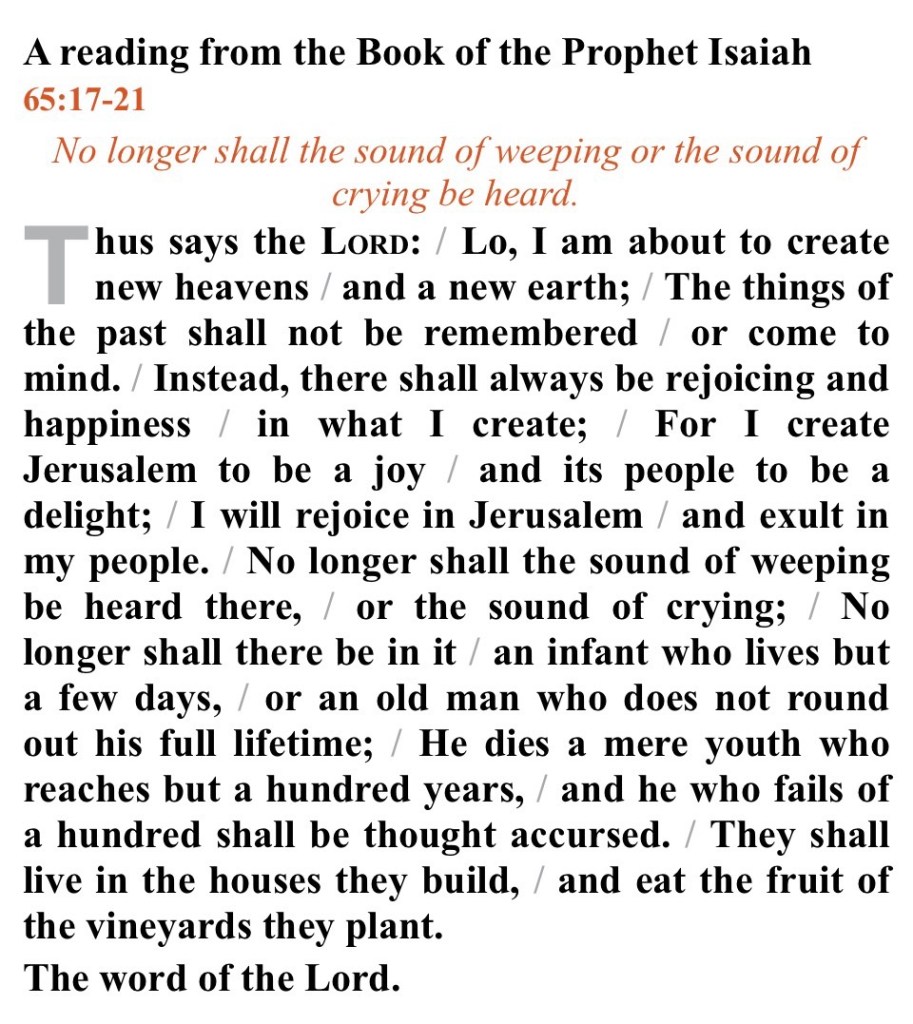
This passage from Isaiah (65:17-21), which is the Old Testament reading for mass today (March 16, 2026), is meant to be a promise of hope. The image it presents – an entirely new reality, in which the past tears are wiped away and only joy exists, where no child dies young and the norm is that we live beyond a hundred years – is meant to encourage a downtrodden people in a difficult time. It’s not like this now, but someday it will be.
I have to be honest, though: the gap between here and there is more disturbing than encouraging to me. Every day, I see stories about children dying young because of war, either directly from violence, or indirectly, from the humanitarian crises war creates. Even in places of relative peace, disparities between people lead to preventable infant mortality. And, as I fiddle with a project on Pope Francis’ teaching on aging, I’m acutely aware that we live in a time where, while more people are actually living to 100 and beyond, our society values older people less and less.
It’s the last line, though, that haunts me. “They shall live in the houses they build, and eat the fruit of the vineyards they plant.” I have heard the pain of people whose families fled Cuba during Castro’s rise to power, now to discover that their homes, seized by force, belong to others. I have read the stories of survivors of the Rwandan genocide who returned later to discover their would-be killers living in their homes, even wearing the clothes they left behind. And I hear stories now of Palestinian Christians and Muslims being driven violently from their homes in the West Bank by Israeli settlers.
Home is hard to let go of. In Florida, we’ve learned that the hard way; with each hurricane strike, we hear about people who declined to evacuate, and then died in the storm. When reporters and others ask me about this, I encourage them to consider that it can be heart-wrenching to leave a home that contains not only all your possessions, but so many of your memories as well. Our places are a part of us, none more so than the ones we call home. So, like Isaiah’s other aspirational images, the promise that we will live in homes we’ve made our own exposes the gap some feel acutely between here and this mystical there.
I tend to think of myself as a relatively unsentimental, forward-looking person, but the line near the beginning of the passage, “The things of the past shall not be remembered or come to mind,” captures the sadness within the reality gap. I want to remember the past, and the present. I just want them to be closer to the promise of the future than they currently are.
Maybe this melancholy is appropriate for Lent. The gaps unsettle me, because war and disparities and wrenching people from their homes are our own human doing. If we were better, if we recognized that we all belong to each other without exception, those gaps wouldn’t need to exist.
Yet Isaiah’s vision doesn’t rest on the promise that we will become better on our own, or that there is a moral arc to the universe that will nudge us to our better angels organically. Isaiah’s promise depends instead on the inbreaking of divine love to reset the world into a proper order and put us on a different path. That is what we long for, as we wait for Easter and prepare our sails for the gust of Spirit-wind that will push us toward living a fuller Love, which is our one true Home.
 Reading Francis
Leave a comment