We have a Stage 5 God, a Stage 4 Church, and too many Stage 3 leaders.
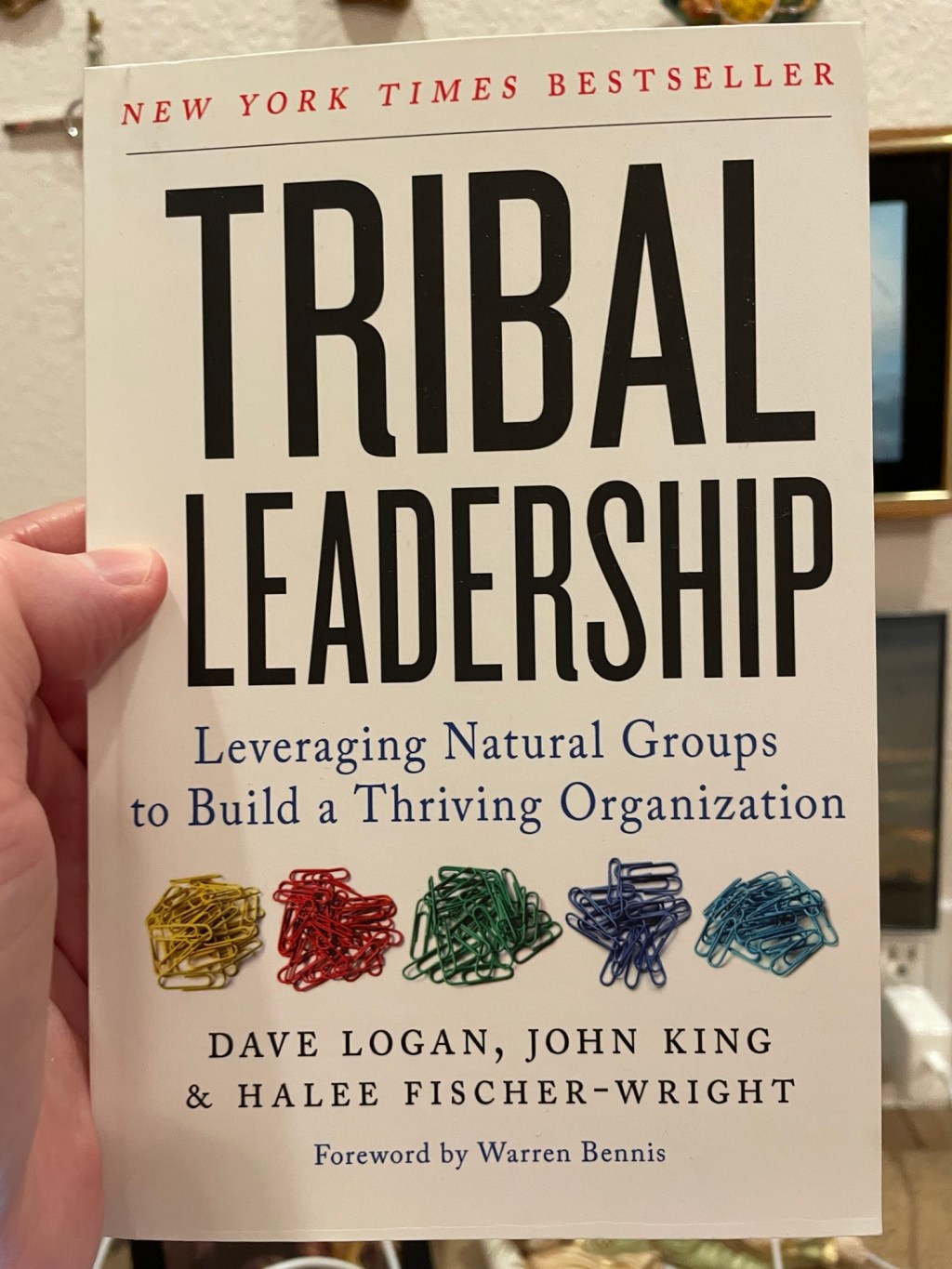
One of my favorite books on leadership is Tribal Leadership by Dave Logan, John King, and Halee Fischer-Wright. Their approach presupposes that people are social in nature, that workplaces are essentially tribes (or tribes of tribes, if they’re big enough), and that a leader’s role is to assess and advance the culture of their tribe by helping its members progress along a 5-stage scale. I’ve been thinking anew about our inherently tribal nature, but I made a new connection between this framework and faith that I wanted to share.
Logan and his colleagues sum up the world view of people in their five stages like this:
- People in Stage 1 think “Life stinks” [they use another word for “stinks”]. It’s a stage of despair and hostility, and they generally advise leaders to stay away from or get rid of people in Stage 1. These are societal outcasts, misfits from which mass shooters come, and you usually only see them connected to anyone else in the form of a criminal gang.
- In Stage 2, people think “MY life stinks”. This is the world of Dilbert cartoons and the stereotype of the folks who work at the Department of Motor Vehicles or some other soul-numbing bureaucracy. Unlike Stage 1, they aren’t hostile or despairing, because they recognize that there is a good life out there; it’s just not THEIR life, so they are depressed and unmotivated.
- People in Stage 3 think “I’m great! (And you’re not.)” They may not say the second part out loud, but they are primarily motivated by their own individual success, which they see in comparison to others. Most of the working world, in the authors’ research, is a ping-pong between stages 2 and 3.
- Stage 4 is the goal that Logan and his colleagues think leaders should shoot for, when people move from “I’m great! (And you’re not.)” to teams that think “We’re great! (And you’re not.)” This transition from individual to team success is at the heart of most management and leadership theory. Again, the “and you’re not” may not be explicit, but the formation of a tribal identity at Stage 4 is a competitive one in which the team’s success or failure is measured against others.
- Stage 5 was an add-on. When researchers found that, rarely and for short periods of time, teams moved beyond the competitive “We’re great! (And you’re not.)” stage to a more universal “Life is great!” mindset, they decided that they needed to acknowledge this other stage. In this tribal culture, success isn’t measured competitively but in pursuit of a history-making goal, and there is no “other” to work against. Everyone motivated by the same core values and lofty goal is welcome in the tribe.
Interestingly, two of the greatest coaches in major college athletics, the late UCLA basketball coach John Wooden and former Alabama football coach Nick Saban, frequently articulated a stage 5 mentality in which their (ridiculously successful) teams were measuring themselves not against competition, but against a standard of excellence itself. If you watch ESPN College GameDay, you can hear the newly retired Saban articulate this philosophy on a weekly basis.
But I digress.
One of the problems Christians face is that we have a Stage 5 God, a Stage 4 institutional Church, and too many Stage 3 leaders who are focused on keeping their flocks at Stage 2. While I am fortunate to know many priests, pastors, and even bishops who buck this trend, when I travel, I notice this mindset, which is all-too-common in Catholic social media and the public statements of domestic Church leaders.
Let me unpack this. Since Genesis 12, when God first tells Abram (not yet Abraham) that “in you all the families of the earth shall be blessed” through the Psalms and the prophets, Yahweh is here not just for Israel but, by extension, all people. In the New Testament, first John the Baptist, then Jesus, then the Early Church double down on this: John calls not just the faithful but soldiers and tax collectors to repentance; Jesus preaches to the outcast Samaritans, heals shunned lepers and demoniacs, and associates with sinners and tax collectors; the Church of the Acts of the Apostles is loaded up with Gentile believers. The Holy Spirit isn’t out to help one nation win over others, but to win everyone over to the God of Love.
Then and now, this is hard for the powers-that-be to swallow. Jesus battles the traditional understanding of a Messiah as a Stage 4 leader of Israel over its enemies. The Early Church grapples with whether Gentiles needed to first convert to Judaism in order to have a seat at the heavenly table. And today, well, the defining principles of the Church tend to pit a faithful few against the heathen, evil world of outsiders. We’re great, and you’re not.
Within the Church, the push against “clericalism” is, in part, a recognition that too many parochial tribes feature a Stage 3 pastor telling Stage 2 members “I’m great. And you’re not.” When the homilies focus on the need for repentance of the flock, and the priest avoids speaking in the first-person plural “we, sisters and brothers”, one can often sniff out a belief that those who are ordained are set apart from the flock to such a degree that all but shouts the Stage 3 mantra. As the focus on synodality seeks to change that dynamic, many of the lay faithful are discovering that, if they aren’t convinced that “my life stinks”, as Stage 2 articulates, there are better ways to spend a Sunday than listening to a harangue that argues otherwise.
The amazing thing, when you stop and think about it, is that Christianity at its most radical and profound focuses on elevating the Stage 1 folks that even Logan and company advise we avoid. Tax collectors, lepers, demoniacs, Samaritans and sinners, for whom Jesus had the most compassion, lived very much in a state of despairing hostility. Jesus not only healed them but included them and developed them into leaders – looking at you, St. Matthew. Over the two millennia of Christianity, Christians have been most attractive (and subversive) when they have invested themselves in lifting up and including the outcast. Today, my favorite example of Christianity in action, Homeboy Industries, exists specifically to help Stage 1 gang members find hope and a community that builds up each Homie into a beloved community until they can see that life really is great.
Every now and then, fortunately not often, I hear a homily or read a statement that makes me understand why Jesus got so worked up at the Temple, and why he lost it with the Pharisees a time or two. When I get off my own high horse, I realize that what gets to me is the attempt to limit God to a smaller scale than Love allows, to shrink the circle of who belongs and raise the walls between us and them.
Ours is a God that wants us to proclaim and to prove that life is great, not just for us (and not you), but for everyone (especially you). The Church, our leaders, heck, all of us need to level up.
 Reading Francis
Leave a comment