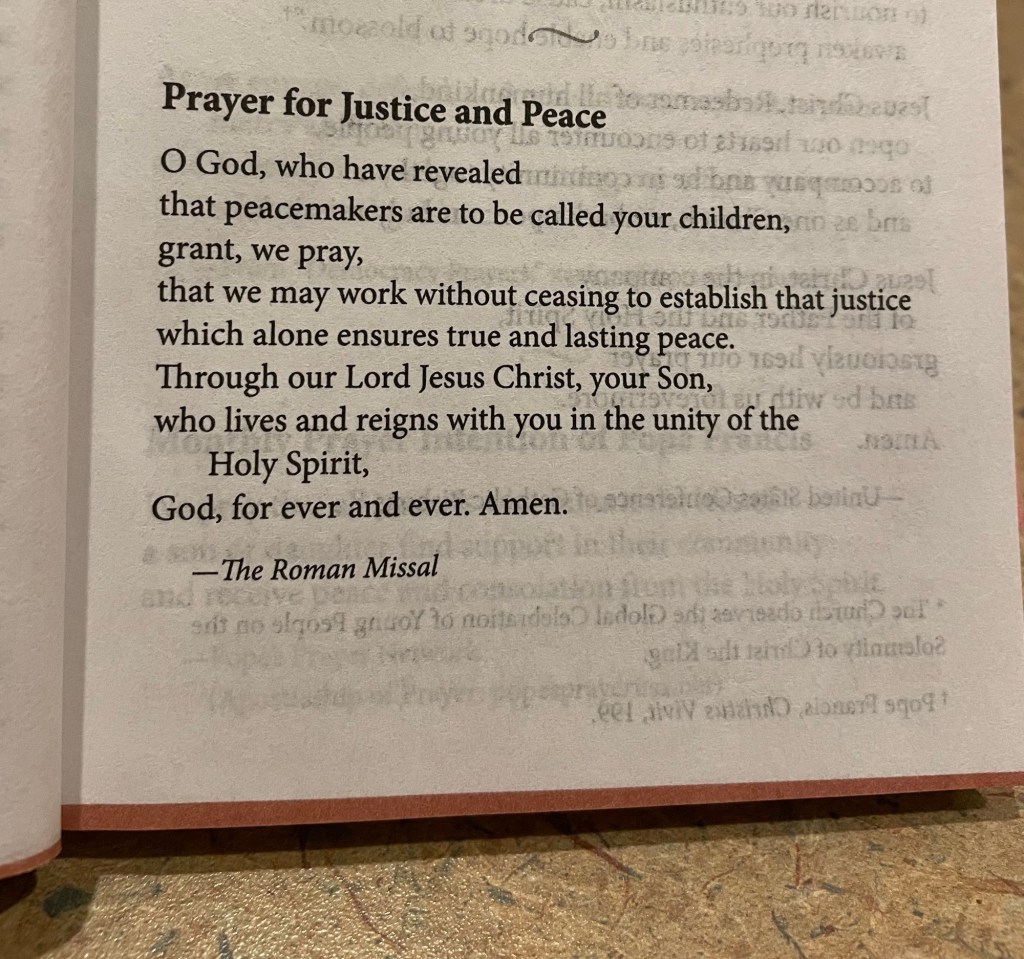
The readings that the Catholic Church uses for Sunday Mass and the ones it chooses for daily Mass don’t intentionally line up; the daily readings generally work slowly through a Gospel and another book of the Bible, while the ones on Sunday will work through a Gospel and another book of the New Testament, with another reading from the Old Testament added in that usually plays off the Gospel for the day. In both cases, you get Psalms that may or may not line up neatly with the rest of the selections.
Sometimes, though, if you squint, you can see themes that run across a week. This week, I see a couple, neither of which should be too surprising, because they aren’t really unique to this week.
One is about justice. While there is a common understanding of justice that is primarily juridical, in which justice is defined by complying with all the rules, the theme that runs through this week’s reading speak to another understanding of justice, that of wholeness and inclusion, especially for the excluded. In Monday’s Gospel (Luke 14:12-14), Jesus tells his followers, “[W]hen you hold a banquet, invite the poor, the crippled, the lame, the blind; blessed indeed you will be because of their inability to repay you.” Those same folks show up on Tuesday in the Psalm (22: 26-27), when the Psalmist says “The lowly shall eat their fill.” On Thursday, in the Gospel (Luke 15:1-10), Jesus gets blasted by his opponents because he hangs out with outcasts and undesirables, and Jesus responds with the story of the shepherd who leaves 99 sheep to find the one that is lost, or the woman who turns the whole house upside down to find that one last coin, then celebrates by throwing a party for her friends.
All that is a precursor for Sunday, when the readings tell the story of Elijah miraculously providing for a widow and her son (I Kings 17), which is paired with the story of the poor woman who gives everything she has to the Temple in Mark 12. But Psalm 146 is the payoff here:
The Lord keeps faith forever, secures justice for the oppressed, gives food to the hungry.
The Lord sets captives free.
The Lord gives sight to the blind; the Lord raises up those who were bowed down. The Lord loves the just; the Lord protects strangers.
The fatherless and the widow he sustains, but the way of the wicked he thwarts.
The Lord shall reign forever; your God, O Zion, through all generations.
That’s what justice looks like, according to the parts of the Bible that the Church reads this week.
Another theme that pops this week is about peace. On Monday, Paul tells the Philippians “[C]omplete my joy by being of the same mind, with the same love, united in heart, thinking one thing. Do nothing out of selfishness or out of vainglory; rather, humbly regard others as more important than yourselves, each looking out not for his own interests, but also for those of others.” The Psalm response that day is “In you, O Lord, I have found my peace.” Tuesday, you get Paul citing an early Christian hymn about Jesus, who “did not regard equality with God something to be grasped. Rather, he emptied himself, taking the form of a slave…and…humbled himself, becoming obedient to death.” Wednesday has Paul telling the Philippians to “Do everything without grumbling or questioning,” while the Gospel has Jesus telling the crowds that, if you’re not willing to give up everything, you should really rethink the disciple thing. And, to return to the Sunday Gospel, what makes the poor woman a hero is not that she’s poor, but that she gives everything she has.
The throughline on these readings is that peace comes by putting others – both God and each other – ahead of our own self-interest. Rick Warren’s oft-cited quote, that “humility is not thinking less of yourself, but thinking of yourself less” seems apt here. This description of peace isn’t necessarily passive; it’s the result of getting over yourself even as you tackle the hard work of justice.
It’s hard for me to balance justice and peace. In a society in which every one of us has some element of power in shaping the whole, justice on behalf of the outcast is hard work. The Scriptural evidence would underscore that, since true justice isn’t achievable by human hands, the work of justice will always be frustratingly imperfect and incomplete for those who take it on. And yet we seem to be called to aspire both to justice and to peace, which among other things is the opposite of frustration. Even if we manage to do this humbly, the gap between what Psalm 146 promises and the best we can manage to pull off seems maddeningly wide. How can we feel peace when there is so much left undone in the pursuit of justice?
I’m reminded of the old encouragement to “work as if everything depended on you and pray as if everything depended on God,” which people attribute to St. Augustine or St. Ignatius of Loyola, though the best evidence might be that John Wesley coined it (shout out to my Methodists!). Perhaps the best example of this balance I can find, though, is from Pope John XXIII, my favorite saint, who used to end the night in prayer saying, “I’ve done everything I can for Your Church today, Lord. But it’s YOUR Church, and I’m going to bed.”
Perhaps similarly, we are called to spend our days working humbly toward justice, while ending them by reminding God that in the end, justice is His, and we’re going to bed.
 Reading Francis
Leave a comment